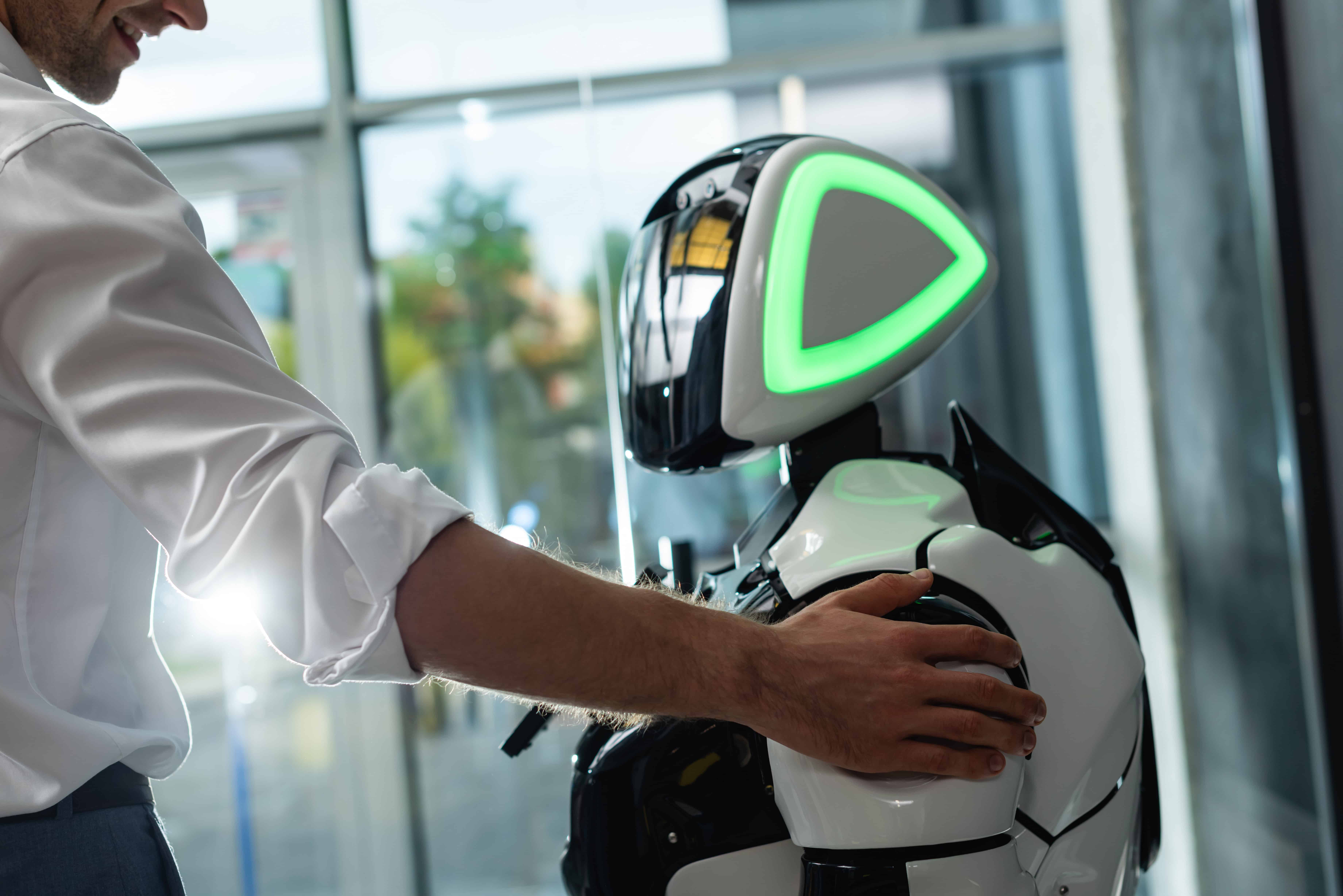
The robot passes the pilot. But the real question is who supervises it, who answers for it, and what happens to the job around it.
Humanoid robots in manufacturing have moved from trade fair demonstrations to real shifts on real production lines. At BMW's plant in Spartanburg, South Carolina, a Figure 02 robot spent ten months on the X3 line, working ten-hour shifts and moving more than 90,000 sheet metal parts. The technology question now has a partial answer. The workforce question is still largely open.
Picture a mid-sized component maker in Emilia-Romagna or Bavaria. The board approves a humanoid pilot for a physically demanding station that has been hard to staff for years. The robot performs. Then the plant manager asks who supervises it on the night shift. The safety manager asks who is responsible after an incident. The union representative asks what happens to the three people on that station. If the project was set up only to test a machine, nobody has an answer ready.
The World Manufacturing Forum, held in Milan on October 22-23, brought around 400 companies together to discuss the future of the sector, with humanoid robotics among the topics on its agenda. The report presented at the event, the 2026 World Manufacturing Report - Navigating the Future of Manufacturing: Trends Compass & Technology Radars, advises companies to treat humanoid robotics as a strategic transformation, not a simple automation project. It says the next three to seven years are likely to determine which organizations succeed. Future Manager World was Knowledge Partner of this edition of the Forum and contributed a best practice to the Report, The Transition from Human Capital to Humanoid Capital. This article draws on both: where the technology stands, where it makes sense, how jobs change, who should own the program, and the mistake to avoid.
Where humanoid robots in manufacturing really stand in 2026
The Report describes most deployments as still at pilot level, and the numbers agree. Counterpoint Research counted about 16,000 humanoid robots installed worldwide in 2025, and the Report puts China's share above 80%. The International Federation of Robotics counts 5 million industrial robots operating in factories. Humanoids are still a very small part of the picture.
The early results are real, and narrow. The Spartanburg pilot itself had a well-defined, repetitive task: retrieving sheet metal parts and positioning them for welding.
Several questions remain open. The Report lists battery autonomy, speed and reliability below that of skilled operators, and a high total cost of ownership. The dedicated safety standard, ISO 25785-1, is still being defined, and the new EU Machinery Regulation applies from January 2027. The Report also expects the market to consolidate from hundreds of developers to perhaps 10 to 20 relevant manufacturers within two to three years.
Europe is moving more slowly. The IFR reports that EU robot installations fell 11% in 2025, to 60,500 units. Italy fell by the same percentage, to 7,824. Meanwhile, BMW's plant in Leipzig is running the company's first European humanoid pilot, with the AEON robot from Hexagon. The Report's advice to validate with targeted pilots before large-scale deployment fits this position.
Where do humanoid robots make sense on the factory floor?
The Report says humanoids should not be seen as the best solution when designing an automated plant from scratch. It sees their greatest value in existing plants, where human constraints limit the use of more fully automated solutions.
That suggests a simple filter. Before approving a pilot, leadership can ask three questions.
Could more conventional automation do this job? If it could, a humanoid may be hard to justify. The case is stronger where the task has to fit a space designed for a person.
Is the task repetitive, physically demanding, and hard to staff? The Report recommends starting with low-risk, repetitive, labor-intensive use cases in logistics, inspection, and material handling, with clear targets for productivity, safety, quality, and return on investment.
Do you know what the people on that station will do next? If the answer is no, the workforce side of the pilot is not ready.
Redesigning work, task by task
Work design matters as much as the technology being introduced. A humanoid takes over tasks before it changes a job. Some roles may shrink, others will appear, and the tasks that remain may no longer add up to the same position.
Our contribution to the Report describes the approach: work has to be redesigned task by task, deciding what goes to the humanoid and creating new roles, such as robot fleet supervisor and robot trainer. New capabilities follow, including robot maintenance, AI operations, safety oversight, and continuous improvement.
BMW describes a similar direction. Its stated aim is to reduce repetitive and physically demanding work so that employees can focus on process understanding, quality checks, and steering workflows. That is a different kind of work, and someone has to build the path toward it.
In practice, this comes down to three decisions. First, list the tasks at the station and mark each one as belonging to the robot or to people. Second, define the new roles, including their grade and pay level. Third, involve line supervisors early. They know where the line's bottlenecks are, which can make them strong candidates to train and supervise the machine.
Who should own a humanoid robot program?
A humanoid program can easily end up inside one function, such as operations or engineering. One function can run a pilot. It cannot answer every question the pilot raises.
The Report is direct on this point. Technologies like these affect engineering, operations, IT, quality, safety, HR, and procurement at the same time. When one department decides alone, the people who will use the technology are involved too late. It recommends cross-functional teams with clearly assigned responsibilities from pilot to scale.
A practical approach is to name one senior executive as accountable, such as the COO or the plant's general manager, with the CHRO involved from the start. They need written answers to a short list of questions. Who supervises the robot on each shift? Who can stop it? Who answers for an incident? What data do its sensors collect about the people working nearby, and who can see that data?
Trust depends on those answers. The lessons in our contribution to the Report are specific: involve workers from the first pilot, be transparent about the data robot sensors collect, and clarify accountability for incidents. BMW says employees in Leipzig help decide how the robot is used. Its Spartanburg pilot also led to revised safety concepts, with extra barriers and partitions. Those are the kinds of findings a pilot should produce.
BMW has also created a Center of Competence for Physical AI in Production to evaluate partners and oversee pilots from the lab to the plant. A mid-sized manufacturer is unlikely to build one, but it still needs the function: a named person, a clear mandate, and a standing place on the leadership agenda. We looked at how these demands are changing senior roles in how AI is reshaping manufacturing leadership.
The transition from human capital to humanoid capital: our contribution to the World Manufacturing Report
This theme has run through our work in 2026. In June, the sixth edition of Conversazioni Aziendali, the executive event series we organize in Milan, was dedicated to The Transition from Human Capital to Humanoid Capital, with keynote speakers from leading humanoid manufacturers. In October, as Knowledge Partner of the World Manufacturing Forum, we developed this thinking further and contributed a best practice to the Report under the same title.
The starting point is strategic workforce planning, which can no longer cover human capital alone. It has to find the right balance between human capital and humanoid capital. The real challenge is not replacing people with technology. It is designing organizations where human skills, AI, and automation work together to create more value.
The pathway we have observed in the most advanced companies starts with the C-suite and gradually extends to everyone involved in adoption. Future Manager World has followed this directly, through more than 1,300 hours of upskilling on AI and new technologies delivered in Italy alone.
In our experience, organizations that paired technology investment with structured skills development and evolving organizational models reached effective adoption levels close to 90% and cut the time to full productivity by up to 60% in the roles involved. Two months after the programs ended, about 90% of participants were still applying what they had learned in their work.
These figures come from Future Manager World's own projects, so they reflect one firm's experience. The message is still clear: the most significant results come from managing the transformation as an integrated project of organizational, cultural, and managerial change, and not from the technology alone. In this setting, workforce planning becomes the main tool for governing the balance between human capital and humanoid capital.
The best practice also names leadership as decisive in integrating technology into the organizational model, guiding change, building trust, and managing resistance. The World Economic Forum estimates that 39% of core skills will change by 2030, and that includes the skills of the people at the top.
We covered a related question in our article on servitization, another topic at the Forum: what happens to the leadership team when the way a manufacturer works changes.
The most common mistake to avoid: treating the pilot as a technology test
The mistake to avoid is measuring whether the robot works and leaving everything else for later. In that version, the pilot gets a budget, a supplier, and a technical target. It has no plan for the roles, no owner for incidents, and no conversation with workers until the result is announced.
The risk is easy to picture. The robot meets its target, and the company prepares to scale. Then the real questions arrive together: pay for the new roles, safety rules for shared spaces, data about the people nearby, and a workforce that has spent months wondering what the machine means for them. Scaling can stall at that point, even if the technology is ready.
The fix starts before the pilot does. Give the pilot two sets of targets: one for the machine and one for the organization. By the end, the company should know which tasks move, which roles change, who owns the system, and what workers think of it.
This is where the message of the World Manufacturing Forum becomes practical. The Report closes on the need to move from reactive adaptation to a proactive stance. For humanoid robots, that stance starts in the pilots being designed now.
Key Takeaways
- Humanoid robots in manufacturing are still at an early stage: about 16,000 were installed worldwide in 2025, against 5 million industrial robots in operation. The 2026 World Manufacturing Report advises treating them as a strategic transformation.
- The Report sees their greatest value in existing plants, where human constraints limit more fully automated solutions.
- The practical work is redesigning jobs task by task and creating new roles, such as robot fleet supervisor and robot trainer.
- Ownership should be clear from the start, with a cross-functional team, an accountable executive, and answers on supervision, incidents, and sensor data.
- The mistake to avoid is testing only the machine. A pilot also needs targets for the organization.
Future Manager World works with CEOs, COOs, and CHROs of industrial companies preparing for humanoid robotics. Talk to our team.
Frequently Asked Questions
Are humanoid robots being used in manufacturing today?
Yes, mostly in pilots on repetitive, well-defined tasks. BMW's Spartanburg pilot supported the production of more than 30,000 vehicles, and BMW is now testing a humanoid in Leipzig. Large-scale adoption has not yet arrived.
Will humanoid robots replace factory workers?
They take over specific tasks first, and that changes the jobs around them. Some companies may need fewer people in certain roles, while new roles such as robot fleet supervisor and robot trainer are emerging. The result depends on how the work is redesigned.
Who should own a humanoid robot program?
The 2026 World Manufacturing Report recommends cross-functional teams with clearly assigned responsibilities, because operations, engineering, HR, safety, and IT are all affected. A practical approach is to name one senior executive, such as the COO or plant general manager, as accountable.
What does the 2026 World Manufacturing Report say about humanoid robots?
It advises treating them as a strategic transformation rather than an automation project, starting with targeted pilots on repetitive tasks, and preparing governance and the workforce early. It sees their greatest value in existing plants.